


Recent Posts
Category
A piece of wire and a diode can reduce huge cost
Today we will discuss one very useful trick to improve and reduce the overall cost and reliability of a popular unit in the motor control industry. As we all know, as depicted in figure -1, a standard topology of a fractional motor controllers electronics consists of, 1-ϕ AC input, step-down transformer, bridge rectifier and linear regulators to supply the drivers and micro-controller.
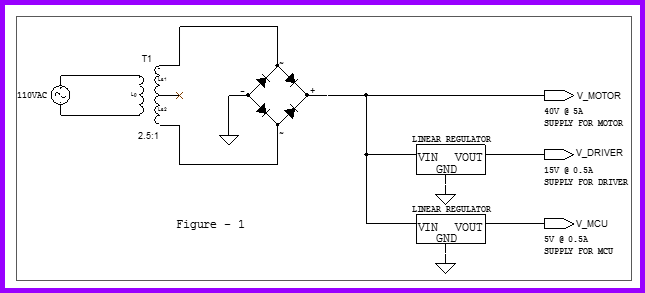
Normally bus voltage is in the range of 40VDC of delivery current at 5A to 15A. I have seen this standard implementation in almost 80% of motor drives I’ve come across. There is nothing wrong with this configuration except the linear power supplies’ efficiencies and amount of heat dissipation. Deriving 15V from 40V with a linear regulator at 0.5A load, the system will need a large heat sink and a cooling fan to dissipate 12.5Watt’s of heat. Even worse, if a 5V supply is derived with a linear regulator, due to too much potential difference, the cooling system has to be capable of dissipating an additional 17.5 Watts of heat. On top of these, 3-ϕ bridge inverters and switching loss introduces a sizable amount of heat. Typically, these three sources of heat are tied to a common heat sink to save cost. Each component tied into the common heat-sink runs at a very high temperature from thermal derating, thermal run-away, etc.
Is there a better way to overcome this thermal problem? Yes. One can replace the linear regulators with switching regulators. The problem with switching regulators is the higher peak current requirement which in return creates a higher potential difference, and turns this into another problem by introducing more costly components.
There is an alternate solution by adding (1) wire and (1) diode to overcome this issue. As shown in figure – 2, using the method of center tap secondary, we can generate low voltage DC from half-wave rectifying for the linear regulators
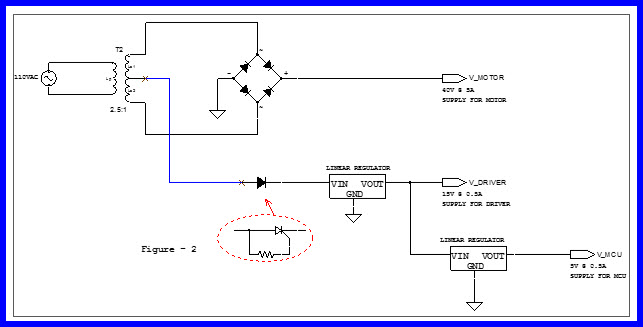
This will reduce the heating by 66%. One note of Importance to keep in mind here is: the center tap is not a ground reference of the system, unlike a full-wave rectifier.
Operation of this half-wave rectifier will be different than an ideal half-wave rectifier. When the center tap is at a higher potential than the lower end of secondary, the diode will conduct and the current will charge the filter capacitor and provide the load current and the return current will flow thru the diode of lower arm of the bridge rectifier.
If load is too small, one can replace the diode with a SCR by setting the appropriate firing angle by means of a resistor, diode and capacitor. This will bring the output of the half-wave rectifier down to an adequate input voltage of the linear regulator.
If we want further optimization, we can replace the 5V linear regulator with a switching regulator to be tied to the half-wave rectifier, as shown in figure -3.
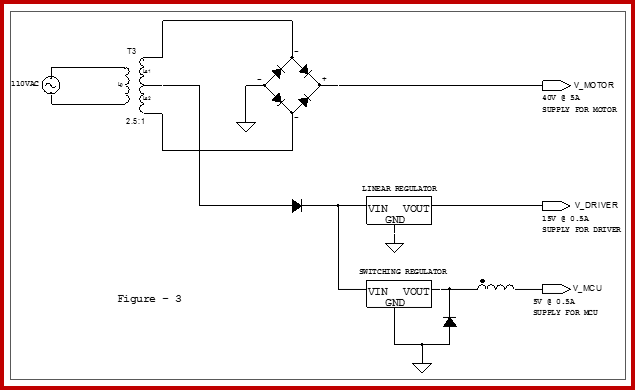
Now we have about 20V from the half-wave rectifier, and an output of 5V. The potential difference went down by 10V which will reduce the peak current requirement for the switch. The efficiency of the switching regulator is normally in the range of 90% to 95%, and will reduce the heating to 10% of the original topology.
With a SCR half wave rectifier and switching regulator, the heat sink is not required; temperature will not rise greater than 20˚C. This eliminates the cost of a heat sink as well as thermal failures.
This article was written by Sam Sangani Jr., PNC Inc.’s Fellow Design Engineer. You can reach Sam via e-mail at sam@pnconline.com
Written by Sam Sangani

Sam Sangani is the President & CEO of PNC Inc., a Nutley, NJ based Printed Circuit Board manufacturer. Sam graduated from L. D. Engineering College with a BS Degree in Mechanical Engineering. He also continued his education and graduated from Steven’s Institute of Technology where he acquired a Master’s degree in Computer Science.
After completion of his BS, Sam worked as a QC Manager, for Xerox, Romania and London. He was responsible for the Quality Control of Cable and Wire Harness imports from Romania. After completing his Master’s Degree, he worked as a Senior Programmer with IBM, Tucson, Arizona. Sam was responsible for leading the Mainframe System Programming Team.
In 1997, Sam acquired PNC INC., a Nutley, NJ based PC Board fabrication Shop. From 1997-2013, Sam has made tremendous improvements and changes within PNC INC., as he added many new Products and Technologies in PNC’s portfolio. With his proven track record and leadership, PNC has never had an unprofitable year and has continued its growth yearly since 1997.
His current responsibilities are Strategic Planning, Corporate Management, New Business Ventures, Sales & Marketing, Trade Shows, Professional Services and leading productive teams to achieve peak potential. He has also utilized Lean Management techniques which have built a foundation for PNC’s high-paced growth. Sam also enjoys real-estate investing, web design & SEO, trading stocks, options, futures and Forex markets.


